
Tour at a Glance: Quick Summary
Before diving into the details, here's everything you need to know about this tour in one place.
| Price Range | Approx. $100–$150 USD (see GetYourGuide for current pricing) |
|---|---|
| Duration | Approx. 3–4 hours (evening / night tour) |
| Advance Booking | Required — walk-ins not accepted |
| Meeting Point | Yokohama area (exact details sent after booking) |
| Driver's License | Not required — professional driver included |
| Languages | English & Japanese |
| Group Size | Small group (approx. 1–4 guests) |
| Vehicles | Mitsubishi EVO, Subaru WRX, or Nissan Skyline (one per session) |
* Prices and details are subject to change. Always confirm the latest information on the official GetYourGuide booking page.
What Is This Tour, Exactly?
The Heart of the JDM Night Run
"EVO, WRX, Skyline – JDM Night Run to Daikoku" is a nighttime driving tour that takes you to Daikoku PA — a parking area on the Shuto Expressway Bayshore Route that has become one of the most famous spontaneous car meets on the planet. This is nothing like a tour bus.
You'll be riding in one of three legendary machines: the Mitsubishi Lancer Evolution, the Subaru Impreza WRX STI, or the Nissan Skyline — all high-performance all-wheel-drive sports cars that defined Japanese motorsport culture from the 1990s into the 2000s. Riding alongside a professional driver as you carve through the Yokohama night on the Shuto Bayshore Route is something no YouTube video can replicate.
What Actually Happens at Daikoku PA
Daikoku PA is a service area off the Shuto Expressway Bayshore Route in Tsurumi, Yokohama. During the day it's unremarkable. On weekend nights, it transforms into a completely organic, unscheduled gathering of tuner cars that draws enthusiasts from across Japan.
GT-R R34s, Supra MK4s, RX-7 FDs, Impreza GDBs, Lancer Evo IXs — it's not unusual to see 200 to 400 rare JDM machines in a single evening. There's no sponsorship, no official car show, no entry fee. Owners simply show up. That raw, self-organized energy is what makes Daikoku PA unlike anything else in the world.
How the Tour Flows
- Meet-up (approx. 7–8 PM) — Rendezvous with your guide/driver at the designated Yokohama meeting point. Vehicle briefing and safety walkthrough.
- Night Run Begins — Hit the Shuto Expressway Bayshore Route and cruise toward Daikoku PA with Yokohama Harbor lighting up the skyline (roughly 15–25 minutes).
- Free Time at Daikoku PA (1–2 hours) — Wander the parking area freely. Chat with car owners, hunt for the perfect shot, soak it all in — it's completely unstructured.
- Return Night Run — Back on the expressway for the drive home, wrapping up at the original meeting point.
The real value here isn't the car ride — it's the access. Getting to Daikoku PA on your own as a visitor is genuinely difficult without expressway access. This tour cuts through all of that and drops you right into the beating heart of local car culture. For the price, I think it's a bargain. — The author, with 10+ years covering JDM culture
Insider Tips for Getting the Most Out of Daikoku PA
Timing Is Everything
Arriving before 9 PM means fewer cars and room to breathe — ideal for wide establishing shots of the whole lot. By 10 PM, it's wall-to-wall metal and elbow room becomes scarce. The tour is typically scheduled with this in mind, but there's nothing wrong with asking your driver to arrive on the early side if you're serious about photography.
The Unwritten Rules of Photography at Daikoku PA
There's an etiquette to shooting at Daikoku PA that no one will formally explain to you. Get it wrong and things get awkward. Here's what to know before you go:
- Always ask before shooting inside someone's car or using flash directly on their build.
- Try to frame out license plates — or blur them in post. It's considered respectful.
- Don't crowd a car that has its engine running; give it space.
- If an impromptu demo run kicks off with tire smoke, step back — never stand in front.
How to Break the Ice with Local Owners
"That's sick" works in any language. A genuine compliment — even just pointing at an engine bay and giving a thumbs-up — gets smiles every time. Your guide bridges the language gap in English and Japanese, so lean on them and don't be shy about engaging.
What to Bring — Don't Show Up Empty-Handed
- Smartphone (fully charged) — Night mode on a modern iPhone or Android flagship is genuinely excellent. You don't need a DSLR.
- A light down jacket or windbreaker — Yokohama's waterfront gets cold at night year-round. From October through March, it's not optional.
- Comfortable sneakers — Daikoku PA is a big lot. Expect to walk 1–2 km.
- A little cash — The vending machines inside the service area are usually cash-only.
Ticket Options: Basic Plan vs. Combo Upgrade
GetYourGuide may offer more than one participation option for this tour. Here's how they generally break down — pick based on your budget and what you want out of the night.
| Feature | Basic Plan | Combo / Upgrade Plan |
|---|---|---|
| Vehicle | EVO / WRX / Skyline (assigned day-of) | Vehicle preference or premium car |
| Daikoku PA Visit | ✓ Included | ✓ Included |
| Night Run Route | Daikoku PA round-trip (standard route) | Extended route, multiple stops |
| English Guide Support | ✓ Included | ✓ Included |
| Approximate Price | $100–$120 | $130–$160+ |
| Best For | First-timers, value-focused travelers | Return visitors, specific vehicle requests |
* The above is for reference only. Confirm actual options and pricing on the GetYourGuide booking page.
Which Should You Choose?
If this is your first time, the Basic Plan is more than enough. Daikoku PA itself is the main event — the specific car matters less than the timing and the energy of whoever you're with. If you're coming back and have your heart set on a particular model, the Combo Plan is worth the extra spend for the vehicle request option.
Timing the Visit: Daikoku PA's Golden Hours and Best Seasons
The Best Nights of the Week
The scale of Daikoku PA's car meet varies considerably by day. The biggest turnouts happen on Friday night into Saturday morning and Saturday night into Sunday morning. Weeknight visits are quieter but have their own appeal — you can actually spend time with each car without the crowd.
How the Night Unfolds Hour by Hour
- 8–9 PM — Cars begin trickling in. This is the golden window for composition shots before the lot fills up.
- 9 PM–11 PM — Peak hours. Hundreds of cars, a wall of exhaust notes, and maximum human energy. The quintessential Daikoku PA experience.
- 11 PM–1 AM — The crowd begins to thin gradually. Great window for time-lapse footage.
- After 1 AM — Only the die-hards remain; the conversations get more personal and technical. (The tour typically wraps before this point.)
Best Seasons of the Year
Daikoku PA runs year-round, but the sweet spots for a tour visit are May–June (just before rainy season) and September–November (autumn clear skies). Temperatures are comfortable, the nights are crisp, and local turnout tends to be strong.
Mid-summer (July–August) brings oppressive heat and humidity at night, which can deter even regular attendees who worry about their engines running hot. Winter (December–February) can drop to near freezing after midnight, so dress warmly if you go.
The Photographer's First 30 Minutes
The half hour immediately after you arrive is your "golden window" — the last chance to frame cars cleanly before the lot turns into a sea of people. The moment the tour vehicle rolls in, prioritize wide establishing shots first, then work your way in toward individual builds. Lock in that routine and you'll never regret it.
Saving Money: Group Rates, Early Bird Deals, and Smart Booking
Groups Often Get a Better Per-Person Rate
Because this type of JDM night run is small-group by design, the per-person cost can shift based on how many people are booking together. Coming as a group of three or four is often more cost-effective than two individual tickets. If you're bringing friends or family, check whether a group option is available before booking separately.
The Case for Booking Early
- Some operators offer early-bird discounts when you book 2–4 weeks in advance.
- Dynamic pricing means popular Saturday-night slots can cost more — Friday and Sunday nights may come in slightly cheaper for the same experience.
- GetYourGuide periodically releases promo codes for limited periods — worth checking before you confirm.
Use the Free Cancellation Window Strategically
Many tours guarantee free cancellation up to 24 hours before departure. That means you can provisionally book multiple dates, monitor the weather forecast and your schedule, then cancel the ones you don't need — all at no cost. Just read the specific cancellation terms on the booking page before relying on this approach.
Bundle for a Lower Total Cost
Booking a Daikoku PA night run and a separate drift lesson individually can cost more than booking them through the same operator in sequence. Repeat customers and referrals sometimes unlock discounts as well — ask your guide directly on the first tour. It doesn't hurt to ask.
The Cars Up Close: What Makes the EVO, WRX, and Skyline So Special
You might already know the term "JDM," but understanding why these three cars command such fierce global devotion will transform how you experience the ride.
Mitsubishi Lancer Evolution (EVO)
The Lancer Evolution was born out of Mitsubishi's World Rally Championship campaign — a road-legal weapon engineered to win on gravel and tarmac stages around the world. From the original 1992 model through to the final EVO X in 2015, it evolved across ten generations without losing the plot.
The 4B11 or 4G63 turbocharged four-cylinder (depending on the generation) produces 280–400+ horsepower in tuned form. Its proprietary Active Yaw Control (AYC) and Active Center Differential (ACD) system — distinct from a conventional symmetrical AWD layout — gives it a corner-exit sharpness that feels closer to a race car than a road car.
- Sweet spot generations: The EVO VIII (CP9A) through EVO IX (CT9A) are widely considered the definitive finished form — balanced, responsive, and deeply satisfying.
- Signature sound: The 4G63's rev note and the surge of a boost hit arriving all at once — "on-off" turbo delivery that will stay with you long after the ride.
- Market value: As of 2025, a clean EVO IX GSR commands ¥4–7 million or more on the Japanese domestic market — and climbing.
Subaru Impreza WRX STI
The WRX shares its DNA with the Lancer Evolution — both cars were forged in the crucible of World Rally Championship competition. The original 1993 Impreza WRX traded blows with the EVO for rally championship titles for over a decade. Colin McRae and Richard Burns both won WRC championships behind its wheel.
The horizontally-opposed (boxer) turbocharged four-cylinder — the EJ20 or FA20 — produces a sound completely unique in the automotive world. That burbling, uneven idle and the pressurized exhaust note at full boost are as instantly recognizable to car people as a Harley-Davidson V-twin is to motorcycle fans.
- Key trait: Subaru's Symmetrical AWD layout — with the drivetrain running perfectly centered — lowers the center of gravity and contributes to the WRX's renowned straight-line stability.
- Beloved generations: The GC8 (original Impreza), the GDB, and the GRB are all highly sought-after. Values have risen sharply across the board.
- That sound: The low-RPM "potato potato" boxer rumble is what Subaru fans call the "boxer sound" — an identity marker for the entire brand.
Nissan Skyline (GT-R)
The Skyline nameplate dates back to 1957, but the car that put it on the global map was the R32 GT-R launched in 1989. Nicknamed "Godzilla" by the Australian and European motorsport press, the R32 carried the ATTESA E-TS AWD system and the twin-turbocharged RB26DETT inline-six to 29 consecutive victories in Group A touring car racing — a record that still stands.
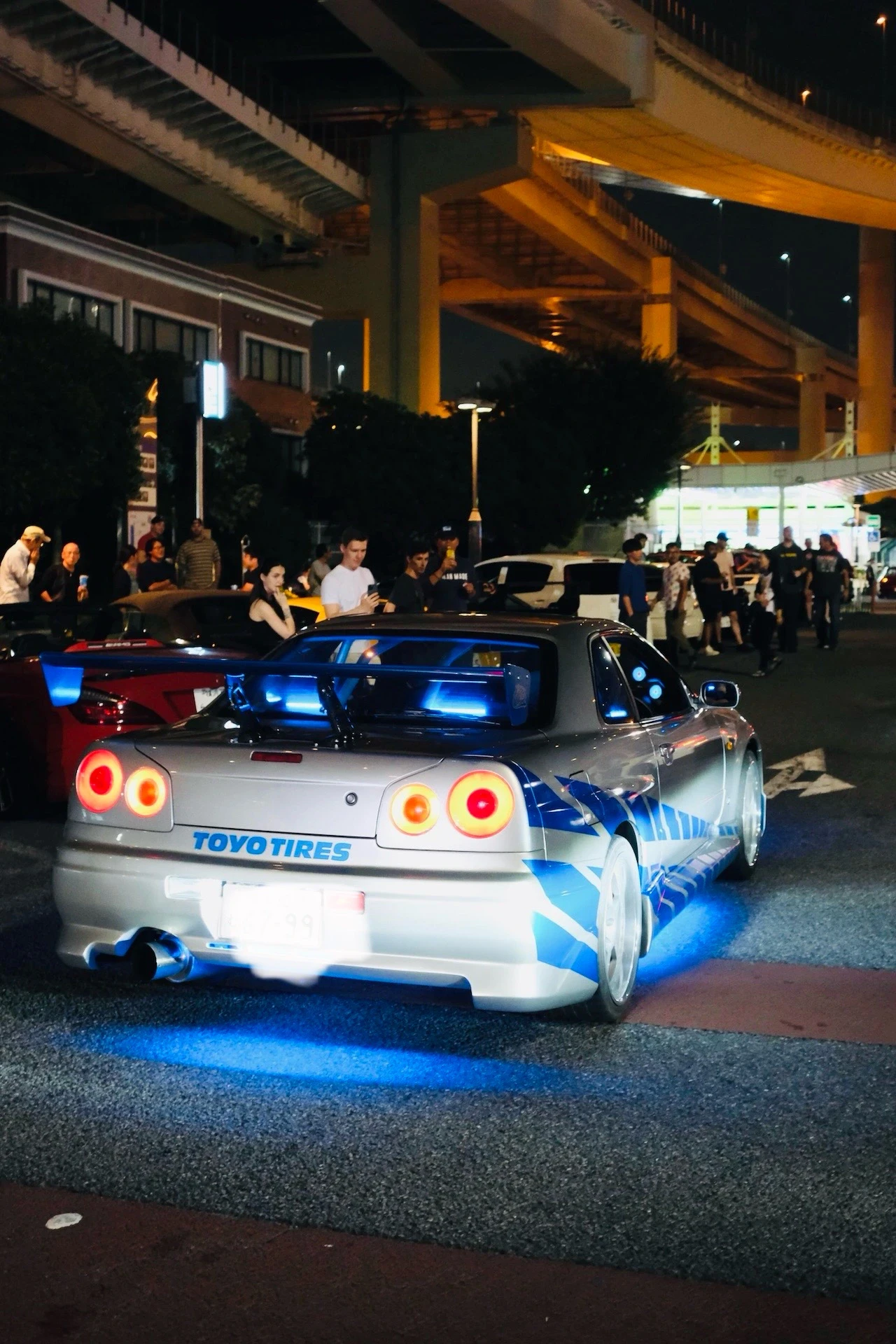
On this tour, you're most likely to encounter an R33 or R34 generation Skyline. The R34 is the one Brian O'Conner drives in 2 Fast 2 Furious (2003), making it arguably the single most iconic car in JDM fan culture worldwide. In today's collector market, a clean R34 V-Spec II routinely sells for over ¥10 million.
- Engine: RB26DETT — 2,568cc inline-six, twin turbocharged. Factory-rated at 280 hp (Japan's voluntary gentlemen's agreement at the time); capable of 600–800+ hp with serious modification.
- HICAS (four-wheel steering): Nissan's rear-wheel steering system improves high-speed stability through sweeping corners — a technology that presaged what mainstream sports cars would adopt decades later.
- Cultural footprint: The Skyline appears in "Wangan Midnight," "Initial D," and countless other Japanese car manga and anime — its legend runs deep with audiences of all ages, East and West.
Of the three, the Skyline delivers the most drama. The moment an RB engine climbs into its top-end powerband is something photographs and videos cannot capture. That said, for sheer day-to-day usability and mechanical confidence, the WRX wins easily. First-timers are usually most surprised by the EVO — the AYC system makes corners feel almost telepathic. Honestly, all three are the right answer.
Daikoku PA: A One-of-a-Kind Fixture on Japan's Car Culture Map
How Daikoku PA Became World-Famous
Daikoku PA's global reputation grew in lockstep with the internet. Local drivers' photos and videos spread across early forums and eventually social media, broadcasting a simple message to car fans everywhere: "This is where the real JDM culture lives." The reputation has only grown since.
It sits in Tsurumi, Yokohama, adjacent to the Daikoku Futo interchange on the Shuto Expressway Bayshore Route, surrounded by the industrial port landscape of Yokohama Harbor. Unremarkable by day — but under the arc lights at night, with several hundred tuner cars filling every space, it's unlike anything else on earth.
Understanding the Layout
Daikoku PA is centered on a large oval lot surrounding a service building (restrooms, vending machines). During a big car meet, the parking area naturally self-segregates into informal zones — a GT-R cluster here, American muscle over there, VIP slammed cars along the far wall. Your tour guide knows the layout well and will walk you through each section so you don't miss anything.
Things You Might Witness at Daikoku PA
- Flame-throwing exhausts — High-boost cars with anti-lag or crackle maps sometimes spit flame on overrun. A GT-R doing this at night is genuinely spectacular.
- Underglow and custom lighting — LED strips illuminating the tarmac beneath a car. Classic old-school JDM style, still alive and well.
- Stance builds — Cars slammed to the ground with extreme camber, prioritizing aesthetics over conventional drivability. It's a whole philosophy.
- Engine bay shows — Popped hoods displaying meticulously detailed engine bays — polished intercoolers, carbon airboxes, painted block covers. Looking is the whole point.
A Note on Police and Enforcement
Kanagawa Prefectural Police patrol Daikoku PA regularly, and noise violations or dangerous behavior are dealt with swiftly. As a tour passenger, you are not at any personal legal risk — you're simply a visitor observing. That said, don't expect movie-style donuts or tire smoke in the parking area. Daikoku PA is about looking, talking, and shooting. The excitement is in the culture, not stunts.
Expert Insights: Straight from the Scene
"Daikoku Has Changed" — What Long-Time Regulars Say
Compared to the early 2010s, Daikoku PA has shifted somewhat. The explosion of social media brought in more tourists, and some locals now leave earlier than they used to. But the core community — the regulars who show up every weekend without fail — is still very much intact. The operators who have been guiding tours here for years understand this evolution intimately and build their schedules around it.
EVO vs. WRX: The Eternal Debate
For hardcore enthusiasts, being an "EVO person" versus a "Subaru person" is practically a matter of identity. Objectively: the EVO's AYC system delivers superior traction on corner exit, while the WRX's symmetrical AWD wins on straight-line composure and long-haul reliability. Both represent the absolute peak of the production AWD sports car form. If you find yourself wanting to ride both back-to-back, that's your cue — you're already a repeat customer in the making.
Coming Face to Face with an R34 GT-R
I once had a chance to talk to an R34 GT-R owner at Daikoku PA. He laughed and said, "I can't push this car on public roads anymore — I'm too scared of damaging it." The collector value has climbed so high that the car's original purpose — to be driven hard — has become almost secondary. And yet, standing in front of a perfectly maintained R34 under the floodlights, the word "legend" stops feeling like hyperbole.
Final Advice on Choosing Your Tour
If you've read this far, your interest in JDM culture is already well beyond casual. If you're on the fence about booking — consider this a gentle push. Daikoku PA is one of those places you visit once and immediately start planning a return trip. The Basic Plan is the right starting point. After that, the desire to come back and ride a specific car, or stay longer, or shoot with a better lens — it all happens naturally.
Frequently Asked Questions
The most common questions from people considering the Daikoku PA night run tour — answered before you ask them.